


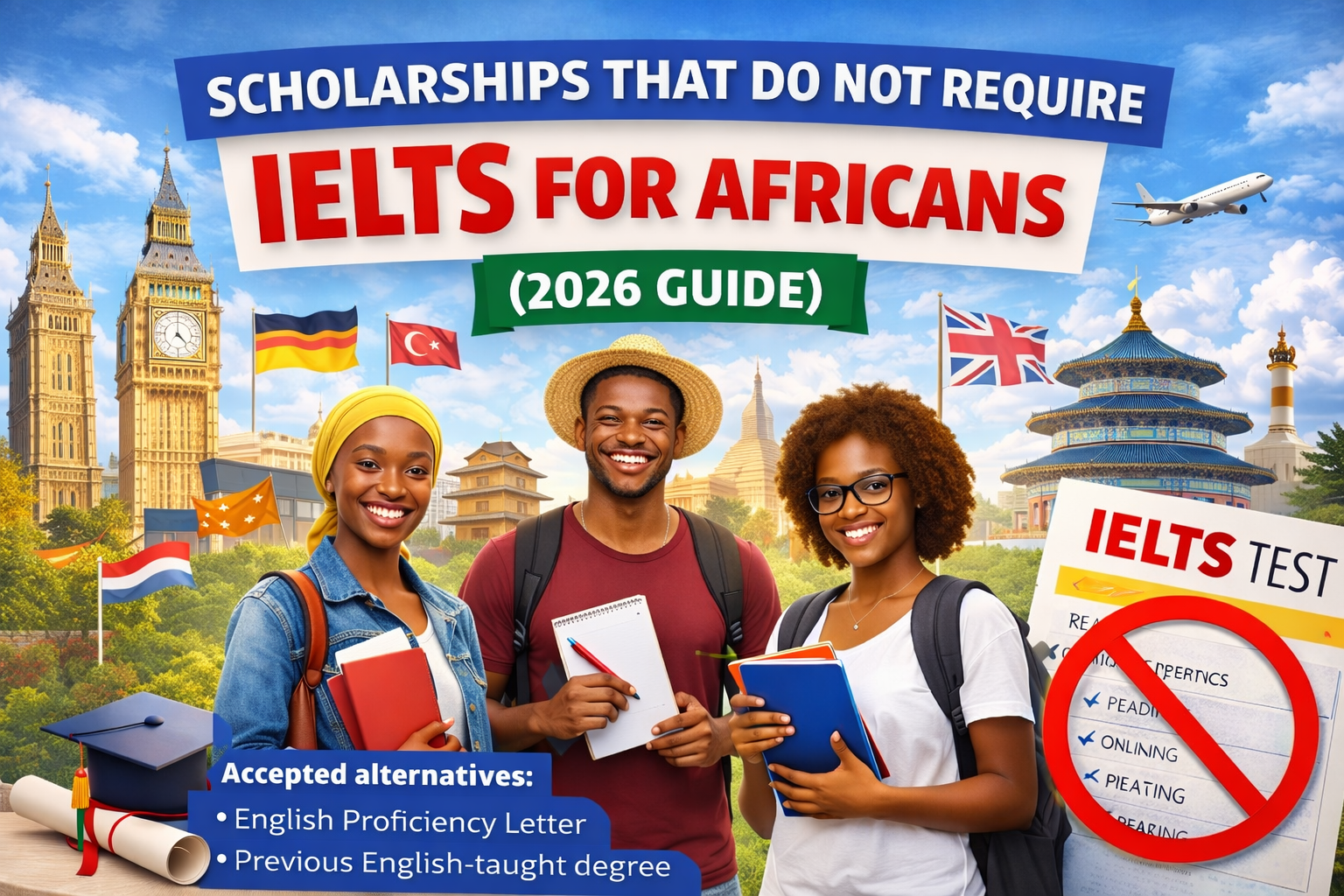
If you’re an African student dreaming of studying abroad but keep hitting a wall because of IELTS, this guide is for you. The good news? Many fully funded and partially funded scholarships do NOT require IELTS, and thousands of Africans are already studying overseas without it.
In this article, you’ll discover IELTS-free scholarships for Africans, countries that waive English tests, and practical alternatives you can use to study abroad in 2026.
Why Some Scholarships Do Not Require IELTS
Many universities and scholarship bodies now recognize that:
- English is the official language of instruction in most African countries
- IELTS is expensive and restrictive
- Academic records and prior education can prove English proficiency
As a result, they accept alternatives to IELTS such as:
- English Proficiency Letters
- Previous education taught in English
- Internal university language assessments
Top Scholarships That Do Not Require IELTS for Africans
1. DAAD Scholarships (Germany)
Germany remains one of the best destinations for Africans.
Why IELTS is not required
- Many programs accept English Proficiency Letters
- Some courses are taught in German or English
- Public universities charge little or no tuition
Covers
- Tuition
- Monthly stipend
- Health insurance
- Travel allowance
2. Erasmus Mundus Joint Master’s Scholarships (Europe)
One of the most competitive but rewarding scholarships.
IELTS Waiver Options
- Several partner universities accept proof of English-taught degree
- Language requirements vary by course
Covers
- Full tuition
- Monthly stipend
- Travel costs
- Accommodation support
3. Chevening Scholarships (UK)
The UK government scholarship removed its mandatory IELTS requirement.
Accepted Alternatives
- University-set English tests
- Proof of previous English education
Covers
- Tuition
- Living allowance
- Flights
- Visa costs
4. Turkish Government Scholarships
Highly popular among African students.
Why IELTS Is Not Needed
- Language training is provided after arrival
- No English test required at application stage
Covers
- Tuition
- Accommodation
- Monthly stipend
- Health insurance
- Flight tickets
5. Chinese Government Scholarships
China offers massive opportunities to Africans.
IELTS Policy
- Not required for most programs
- English-taught degrees accepted
- Chinese language training provided if needed
Covers
- Tuition
- Accommodation
- Monthly stipend
- Medical insurance
6. Hungary Stipendium Hungaricum Scholarship
A fast-growing favorite for Africans.
English Requirement
- IELTS is optional
- Many universities accept interview-based assessment
Covers
- Tuition
- Accommodation allowance
- Monthly stipend
- Health insurance
7. Swedish Institute Scholarships
For master’s students with leadership potential.
IELTS Waiver
- Universities may accept alternative English proof
- Depends on course requirements
Covers
- Tuition
- Living expenses
- Insurance
- Travel grant

Countries Where Africans Can Study Without IELTS
You can study in these countries without IELTS if you meet alternative criteria:
- Germany
- Turkey
- China
- Malaysia
- Hungary
- Norway
- Sweden
- Poland
IELTS Alternatives You Can Use Instead
If a scholarship says “English proficiency required,” it does not always mean IELTS.
Here are accepted alternatives:
- English Proficiency Letter from your university
- Proof that your Bachelor’s or Master’s degree was taught in English
- Online or university-based interviews
- Internal language tests
💡 Tip: Always email the university to confirm accepted alternatives.
Common Mistakes Africans Make When Applying Without IELTS
❌ Assuming IELTS is compulsory for all scholarships
❌ Not requesting an English Proficiency Letter early
❌ Applying late and missing deadlines
❌ Ignoring course-specific language requirements
How to Increase Your Chances Without IELTS
✅ Choose countries flexible with language tests
✅ Apply to multiple universities
✅ Prepare for online interviews
✅ Write a strong motivation letter
✅ Apply early
Final Thoughts
Thousands of Africans are studying abroad today without IELTS. The key is knowing where to apply, what alternatives to use, and how to present your application properly.
IELTS should never stop you from pursuing global education opportunities.
