


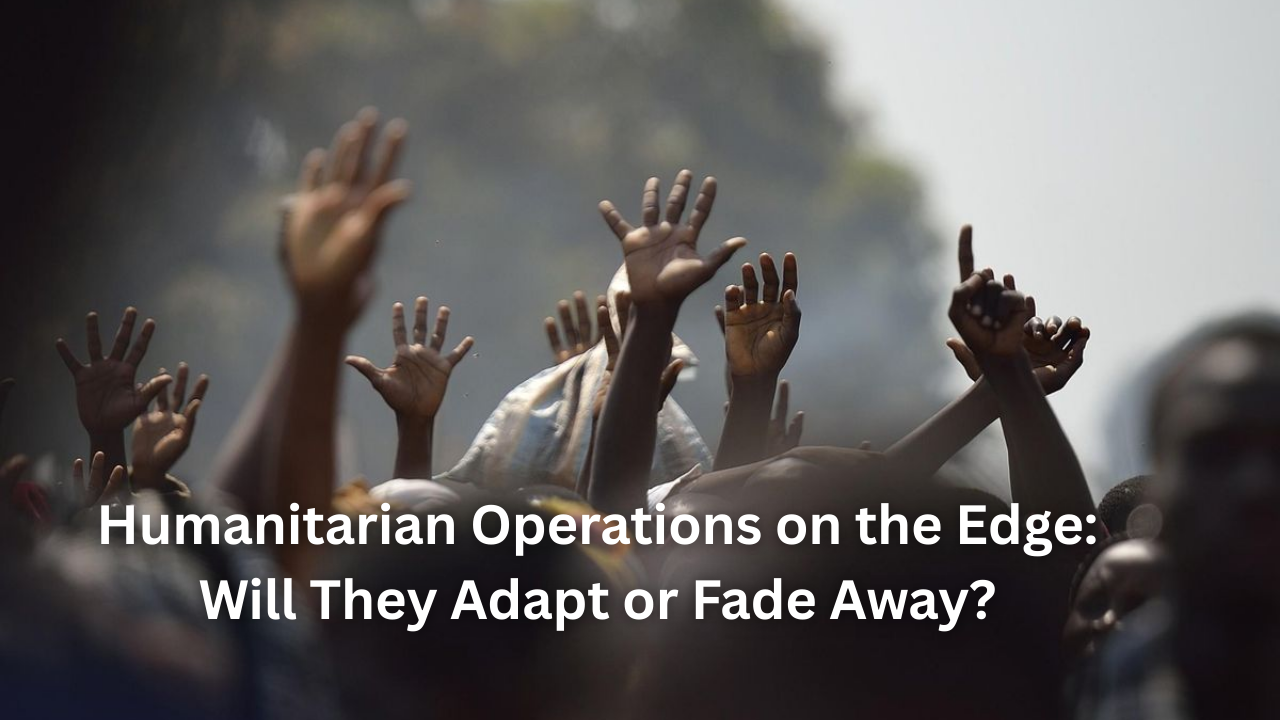
As funding shrinks and crises multiply across Africa and the Global South, humanitarian operations face a defining moment. Will NGOs adapt with innovation and AI or fade away?
The Global Humanitarian System Is Under Pressure Like Never Before
In 2026, humanitarian operations are standing on a knife’s edge. From conflict zones to climate disasters, displacement crises to public health emergencies, the demand for humanitarian aid has reached record levels. Yet, funding gaps are widening. Donor fatigue is real. Inflation is biting. Political tensions are rising. And local communities are demanding more ownership.
The big question is no longer “How do we scale humanitarian response?” It is now:
Will humanitarian organizations adapt fast enough or slowly fade into irrelevance?
For Africa, and especially for frontline countries like Nigeria, Sudan, South Sudan, DRC, and Somalia, this question is urgent.
The Perfect Storm: Why Humanitarian Operations Are on the Edge
Funding Is Shrinking — Needs Are Expanding
Major institutional donors in Europe and North America are recalibrating budgets. Some are shifting focus inward. Others are tightening aid due to domestic economic pressures. Meanwhile:
- Climate disasters are increasing across the Sahel and Horn of Africa.
- Conflict displacement remains high.
- Food insecurity numbers are surging.
The consequences have been massive humanitarian funding gaps. As these gaps get wider the scope of operations across global humanitarian organizations shrink faster to accommodate the slim budgets. Small and mid-sized NGOs are especially vulnerable. Without diversified funding strategies, many risk closure.
Climate Change Is Rewriting the Humanitarian Playbook
There are prevalent floods in West Africa, undying drought in East Africa and defiant Cyclones in Southern Africa. Humanitarian operations were traditionally reactive which means response after disaster strikes.But climate change is demanding predictive, anticipatory action.When predictive tools and analysis become efficient and effective when it is given the attention and approach it desperately needs. However, Organizations that fail to integrate: early warning systems, climate data, risk mapping, disaster preparedness models will inevitably struggle to remain relevant.
The Rise of AI and Digital Humanitarianism
Artificial Intelligence is no longer optional. AI tools are now being used for: - Predicting food insecurity
- Mapping displacement patterns
- Managing supply chains
- Fraud detection in cash transfers
Organizations that embrace AI-driven humanitarian operations will increase efficiency, transparency, and impact. Those that resist digital transformation may be left behind.
The Localization Revolution: Power Is Shifting
For decades, international NGOs dominated humanitarian coordination. Today, communities are demanding local ownership.
Localization means: - Funding local NGOs directly
- Strengthening community-led response
- Reducing overhead-heavy foreign structures
- Building sustainable local capacity
African-led organizations are no longer content being subcontractors. They want leadership roles — and rightly so. Humanitarian operations that ignore this shift risk losing legitimacy.
Adapt or Fade: What the Future Demands
If humanitarian organizations want to survive beyond 2026, they must pivot in five key ways:
Diversify Funding Sources
- Corporate partnerships
- Impact investment models
- Faith-based networks
- Digital fundraising campaigns
- Social enterprise hybrids
Grant dependency alone is no longer sustainable.
Integrate Technology & AI
Digital monitoring, blockchain for transparency, AI analytics, and mobile-first programming must become standard.
The future humanitarian worker will need:
- Data literacy
- Digital coordination skills
- Tech-driven project management capacity
Strengthen Local Partnerships
Instead of parachuting into crises, organizations must:
- Build long-term local ecosystems
- Transfer power, not just resources
- Prioritize community leadership pipelines
Move from Relief to Resilience
Emergency aid saves lives — but resilience sustains them. Future humanitarian operations must integrate:
- Livelihood restoration
- Climate adaptation
- Economic empowerment
- Policy advocacy
Short-term response alone will not secure long-term relevance.
Rethink Operational Costs
Lean operations, remote coordination, digital program management, and shared services can reduce overhead and improve sustainability. The era of bloated humanitarian bureaucracy is closing.
Here’s the twist.
Africa has a unique opportunity even though many of her humanitarian systems are strained, yet it presents a transformation opportunity.
- Youth population is growing.
- Tech innovation hubs are expanding.
- Local civil society networks are strengthening.
- Social entrepreneurship is rising.
African humanitarian leaders who blend technology + local knowledge + sustainable financing may redefine what global aid looks like in the next decade.
The hard truth is some organizations will not survive this shift. Those who resist innovation, depend solely on traditional donors, ignore localization, refuse digital transformation may quietly disappear. But those that embrace adaptive leadership, invest in capacity, and rethink their models will not just survive but they will shape the future.
If you are a development professional, donor, policymaker, humanitarian worker, an African social entrepreneur or NGO founder, you will realise that this moment demands reflection. Let me help you with one of the pointers to ponder on- what side of history will you be on?
Remember, humanitarian operations are not dying, they are evolving. So will you evolve with them or go extinct?
