


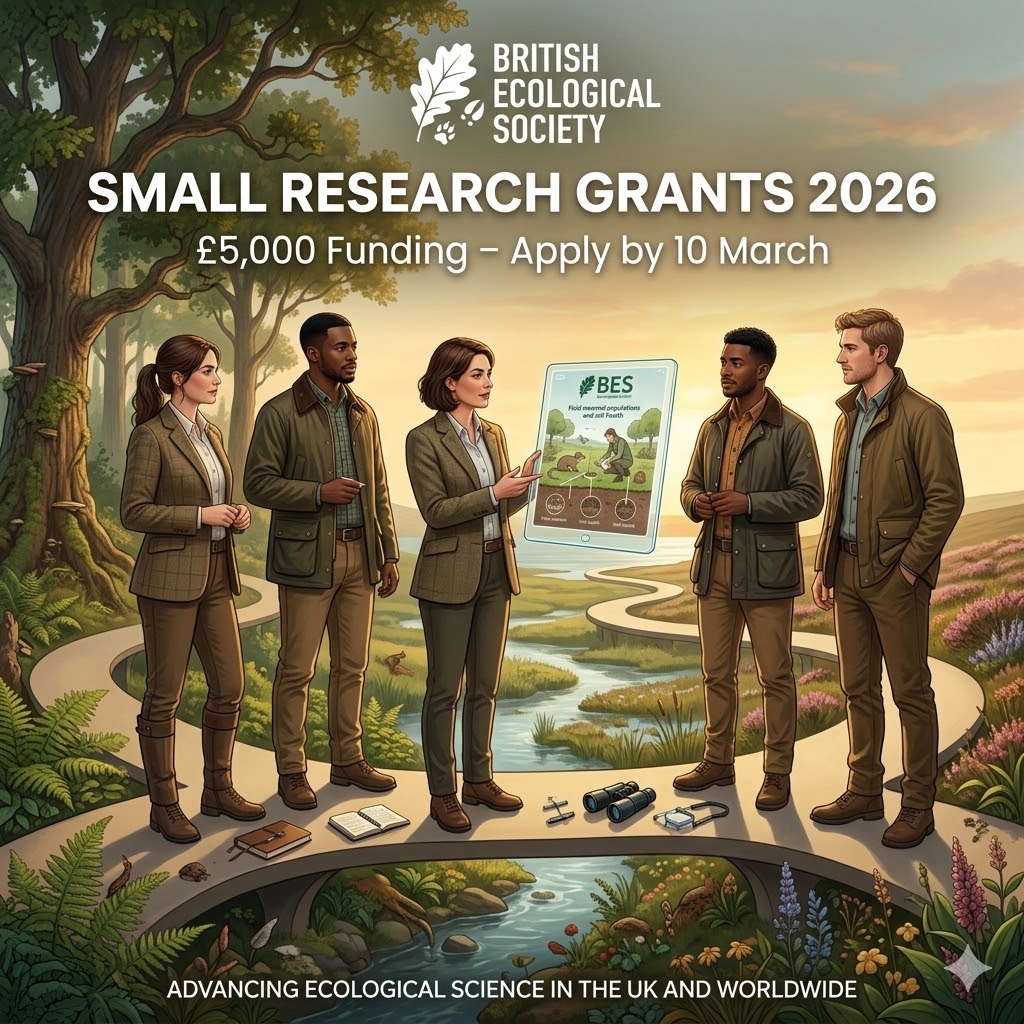
The British Ecological Society (BES) has opened Round 1 of its 2026 Small Research Grants, offering up to £5,000 to support high-quality, innovative ecological research worldwide.
🗓 Competition Opens: 12 January 2026
🗓 Application Deadline: 10 March 2026
💰 Funding Amount: Up to £5,000
🌍 Location: Global (no nationality restrictions)
The scheme is designed to fund independent research projects where alternative funding sources are limited, empowering scientists at various career stages to advance ecological science.
About the BES Small Research Grants
The Small Research Grants programme supports projects with a clear and rigorous ecological science focus. While interdisciplinary approaches are welcomed, non-ecological components (e.g., sociology or economics) must be fully integrated into the ecological objectives of the project.
Priority Areas
BES prioritises:
- Research of the highest international scientific standard
- Projects that demonstrably advance ecological science
- Innovative methodologies applied to established sites
- Established methodologies introduced to novel ecosystems
- Research conducted anywhere in the world
Applicants must clearly explain how their research contributes to ecological knowledge and scientific progress.
Who Can Apply?
Grants are awarded to individual researchers, not institutions. Applicants must hold active membership with the British Ecological Society at the time of application.
General Eligibility Criteria
- Project duration must not exceed 12 months
- Grants cannot fund part of a larger funded study unless BES funding represents the majority or a clearly distinct standalone component
- Not available for undergraduate or master’s degree research
- Fellowship-related research is not eligible
- Expedition participation alone (e.g., Operation Wallacea) is not funded
- Applicants working outside their home country must demonstrate meaningful local collaboration
Funding Limits
- One grant per applicant per year
- Maximum of three grants within five years
- Failure to submit an end-of-grant report will result in ineligibility for future funding
Additional Conditions for PhD Students
PhD students may apply if:
- They do not use the grant as a “top-up” to fully funded research
- The project is distinct from an already funded PhD study
- Funding covers a separate and clearly defined research component
- The project is independent of fellowship-funded work
What Does the Grant Cover?
Successful applicants may receive up to £5,000, with all costs fully justified.
Eligible Costs
- Essential travel expenses
- Short-term research assistance (up to 11 months)
- Small equipment (items must not exceed £2,000)
- Consumables and recurrent research costs
- Living and subsistence costs (if essential and justified)
Not Funded
- Equipment exceeding £2,000
- Institutional overheads
- Applicant salary supplementation
- Tuition fees
- Conference attendance or publication fees
- Bench fees or departmental vehicle hire
This is strictly a research funding award, not a scholarship.
All research outputs must acknowledge BES support in publications and communications.
Application Process
Applications are submitted via the Flexigrant system and must include two reference statements:
- A personal statement from a supervisor, employer, or academic mentor
- A supporting letter from the host institution
Undergraduate and master’s applicants must confirm the research is not part of their degree programme.
Applications cannot be submitted until both references are completed within Flexigrant. Independent submissions via email or post are not accepted.
Applicants are strongly advised to notify referees early to avoid delays.
How Applications Are Assessed
Each proposal is reviewed by three members of the BES Review College.
Assessment Criteria
- Scientific excellence and impact
- Clear ecological contribution
- Feasibility and methodological rigour
- Applicant capability and promise
- Value for money
Because reviewers may not be specialists in the exact research field, proposals should avoid excessive jargon and clearly explain objectives and expected outcomes.
Advancing Global Ecological Science
The Small Research Grants programme reflects BES’s long-standing mission to nurture scientific excellence and global collaboration in ecology.
By funding innovative research worldwide, the Society supports projects that inform:
- Biodiversity conservation
- Climate resilience strategies
- Ecosystem sustainability
- Environmental management policy
For early-career and established researchers alike, this funding provides a valuable opportunity to conduct focused, high-impact ecological research.
